
In Praise of the Destruction: Celebrating the Release of Godzilla: Destroy All Monsters: Remastered

“Tribute to the King” | Art Credit: Valentino Di Pietro Hernandez
Humanity has never been particularly good at letting monsters sleep. Long before cinema gave them a larger screen and iconic soundtrack, we spoke of dragons devouring kingdoms, krakens dragging sailors into the ocean’s abyss, and the Titans of Greek mythology who made the Gods themselves look vulnerable. The modern giant monster is, in many ways, larger in scale across different mediums. We build these monsters from rubber suits and stop-motion puppets, draw them into comic books, collect their action figures, and eagerly wait for the midnight release of the new film installment. There’s something remarkable about a creature capable of ending civilization that can also become a fixture of pop culture and childhood.
Few monsters embody this contradiction more completely than Godzilla. Conceived by producer Tomoyuki Tanaka, directed by Ishiro Honda, and with the special effects of Eiji Tsuburaya, the King of the Monsters made his cinematic debut in 1954. Spawning from Japan still affected by the devastating events of the Second World War and the bombings of Hiroshima and Nagasaki. The atomic monster was less a tyrant and more a historical wound. His arrival helped create the groundwork for kaiju cinema, Japan’s tradition of giant-monster films. The 1954 film also helped define the visual language of tokusatsu, a form of Japanese live-action filmmaking that used inventive practical techniques to make the extraordinary feel tangible, turning everyday life into possible occurrences for fantastic encounters. During the Showa era between 1954 and 1975, the franchise gradually shifted from nuclear terror towards monster battles, introducing rivals and allies like Mothra, Rodan, and King Ghidorah. Some proved popular enough for their own spinoff films. His transformations have often reflected the sensibilities of the filmmakers entrusted with him. In 2016’s Shin Godzilla, Hideaki Anno (Creator of Neon Genesis Evangelion) and co-director Shinji Higuchi (best known for his work on the Attack on Titan films) reimagined the creature as a grotesque, rapidly evolving national disaster, turning the monster into a satire of bureaucratic paralysis and Japan’s response to the Fukushima disaster. Legendary’s Monsterverse, by juxtaposition, has made a blockbuster of Godzilla, forming an uneasy team with Kong and battling an ever-expanding roster of creatures from the catalog of past films. Each reinvention has kept the monster alive, waiting for the next. The franchise’s most remarkable recent adaptation came from Japan. In 2023’s Godzilla Minus One, director Takashi Yamazaki (known for Stand by Me Doraemon) returned the monster to the ruins of postwar Japan and earned the series its first Academy Award for Best Visual Effects. Yamasaki is set to revisit that vision in Godzilla Minus Zero, arriving in North American theatres on November 6, 2026. Nearly seven decades after his debut, Godzilla remains a staple icon of the genre, and continues reflecting the times while delivering the entertaining spectacle of monsters at war.
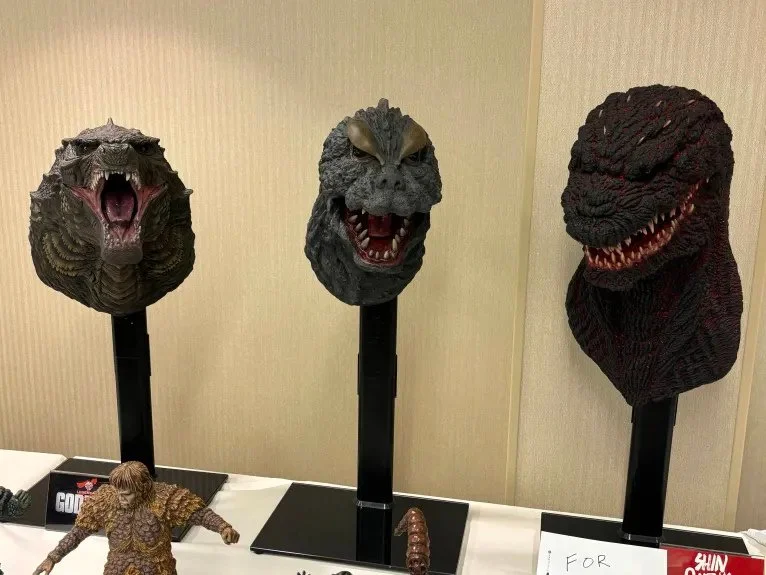
“Godzilla: Through the Years” from Godzilla Con Chicago 2024 | Photo Credit: Connor Braaten
Today, November 3, 2026, the King of Destruction finally returns to the arena. Originally released in 2002 during the sixth generation of console gaming, Godzilla: Destroy All Monsters Melee lets players control monsters they saw on screen. Twenty-four years later, Atari’s Godzilla: Destroy All Monsters Remastered brings the arena fighter back with enhanced graphics and a host of improvements fit for modern consoles.
In Behemoth Presents: Aftershock Volume 1, readers were provided a selection of kaiju and tokusatsu media, accompanied by the zine’s original comic, The First of Its Kind. The volume served as a field guide to the genre. Here, we venture farther, revisiting our selections and what makes each a great entry point into the world of giant monsters.
Legendary’s Pacific Rim (2013)
“So where would you rather die? Here? Or in a Jaegar.”
Guillermo Del Toro, whose work includes Pan’s Labyrinth and the first live-action adaptation of Mike Mignolia’s Hellboy, brings his affection for eastern genres to Pacific Rim (2013). The 2013 film is a Hollywood blockbuster steeped in the spirit of Japanese kaiju cinema and mech anime like Mobile Suit Gundam. In the film’s vision of an imperiled Earth, humanity answers the threat of giant monsters with towering robotic machines called Jaegers, whose pilots must learn to share a single mind. Starring Charlie Hunnam, Rinko Kikuchi, Idris Elba, and Charlie Day, the film delivers action-packed encounters between the monsters and the machines while grounding its battles in sacrifice, cooperation, and a stubborn refusal to surrender in the face of extinction, perfectly introducing the tokusatsu genre.
Studio Trigger’s SSSS. Gridman (2018)
“I am the Hyper Agent, Gridman. Remember your mission!”
Produced by the studio behind Kill La Kill, Promare, and Cyberpunk: Edgerunners, Studio Trigger’s 2018 project SSSS Gridman. Directed by Akira Amemiya and written by Keiichi Hasegawa, the anime series follows Yuta Hibiki, a high school student who awakens without his memories and discovers a mysterious hero named Gridman inside an old computer. In the twelve-episode series, Yuta and his classmates valiantly defend their city against giant monsters, confronting threats reminiscent of transforming machines in the Transformers franchise. The monsters may threaten the city from the outside; however, the more captivating mystery is the story’s progression around the city itself, whose ordinary routines hide a reality far less stable than the monsters attacking it.
Voltron: Legendary Defender (2016-2018)
Reimagining the beloved 80’s animated series, Voltron: Legendary Defender (2016-2018) sends five pilots from Earth into an intergalactic war, where they become the Paladins of Voltron, whose robotic lions can combine into a formidable warrior. Produced by DreamWorks Animation and led by executive director Jaoquim Dos Santos and Lauren Montgomery, whose previous work on Avatar: The Last Airbender and The Legend of Korra, helped establish their reputation for character-driven adventure, the series brings a familiar formula to a new generation. With the colorful camaraderie and familiar pleasures of Power Rangers franchise and the ambitions of a space opera, the paladins can combine with the pull of a lever; however, the alliance behind them is fragile and tested in every new world Voltron’s Paladins set out to save.
Yongary, Monster of the Deep (1967)
“He was just looking for food and we had to kill him, because he got in our way.”
Emerging in 1967, South Korean cinema added a new specimen to the growing bestiary of giant monsters with Yongary, Monster of the Deep. Directed by Kim Kee-duk, the motion picture follows a colossal creature awakened by a nuclear test that rampages around Seoul, leaving citizens and government officials in a scramble for survival and a solution. Made in the wake of The King of Destruction’s international success, Kim Kee-duk’s film brings the entertaining mediums of practical effects, miniature cityscapes, and suitably outsized destruction. As soldiers and scientists struggle to stop the beast, a young boy sees something recognizable as a creature acting on instinct rather than malice. The distinction lends the film a curious tenderness, even as the city becomes less recognizable. For viewers interested in the history of kaiju cinema, Yongary, Monster of the Deep marks an early chapter in South Korean genre filmmaking, capturing a moment when a counterpart began to take on a character of its own.
Toei’s Johnny Sokko and his Flying Robot (1967)
“Giant Robot, obey! Atomic Punch! All your might!”
Part spy-thriller, part monster-of-the-week adventure, the 1967 Japanese animated series Johnny Sokko and his Flying Robot imagines a world where the fate of humanity rests with a young boy, a wristwatch, and a fifty-foot robot capable of delivering an atomic punch. Produced by Toei Company and adapted from Mitsuteru Yokoyama’s manga Giant Robo, the series sends the title character and the peacekeeping agency Unicorn into battle against their adversaries, the Gargoyle Gang, and their barrage of monstrous creations. Although animated, the series draws on the spectacle of Japanese tokusatsu, particularly its interest in enormous mechanical heroes, over-the-top adversaries, and citywide battles. What distinguishes Johnny Sokko, like other media that have succeeded it, is the curious balance between the boy’s vulnerability and the power at his command. Giant Robot can level entire cities and mountains, but he still relies on his relationship with Johnny and his judgment. Their partnership imagines technology not as an independent savior, but as an extension of human will. Their partnership suggests that even the greatest power is only as meaningful as the trust and judgment guiding it.
Tsuburaya Productions Ultraseven (1967)
“First, we must believe in each other. Otherwise, humanity will never be able to grasp peace.”
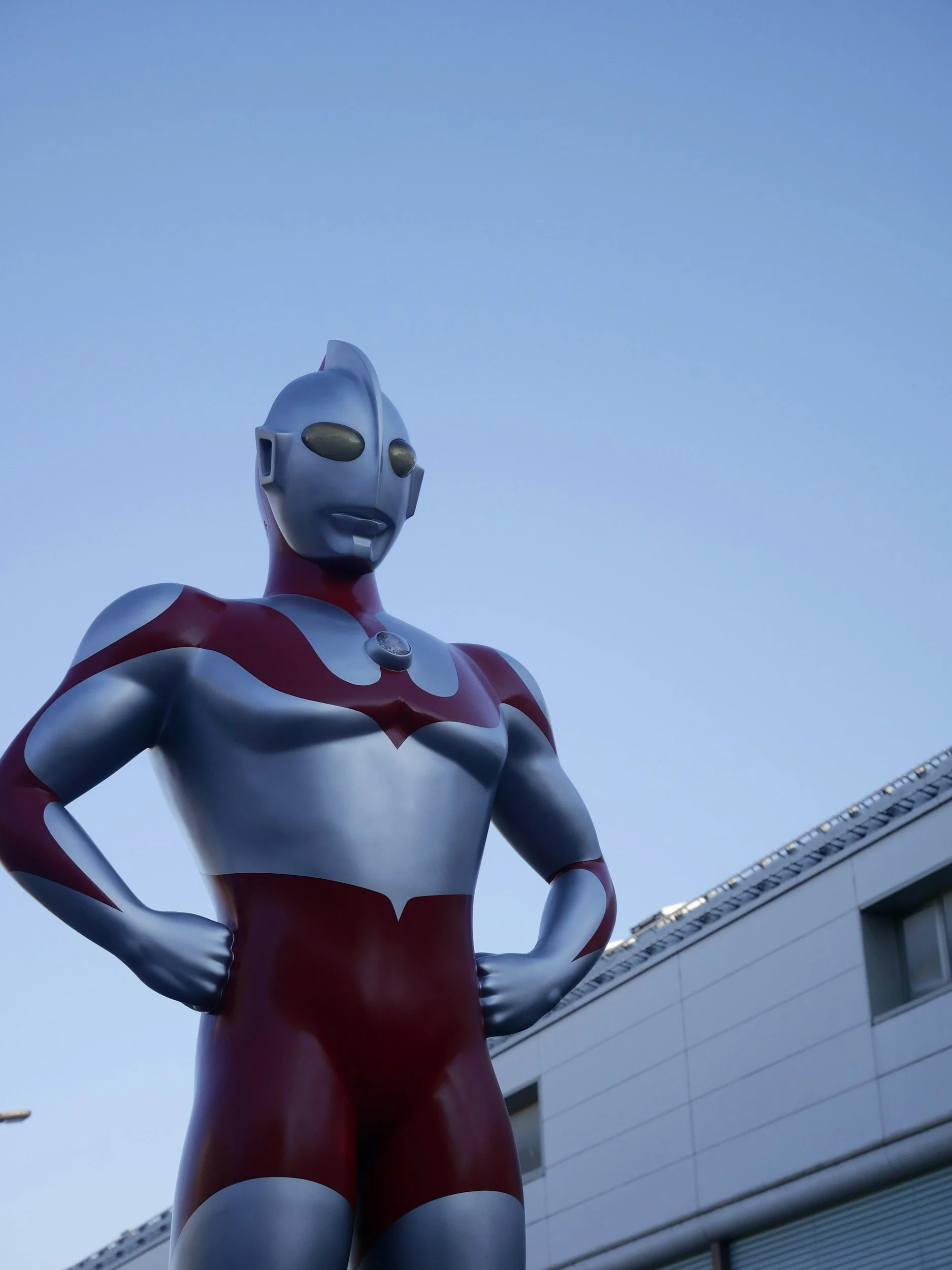
Where traditional giant monster films focused on the anxieties of the nuclear age as a towering force of destruction, Ultraseven approached the genre from a unique angle: the possibility that humanity itself might pose the threat. First broadcast in 1967, Tsuburaya’s science-fiction series draws on the imaginative possibilities of Japanese tokusetsu for live-action filmmaking. The story follows Dan Moroboshi, an alien who joins Earth’s Ultra Guard and secretly transforms into Ultraseven to defend the planet from invaders. Through its encounters with strange, formidable creatures, the series repeatedly made audiences question what is friendly. The series’ influence has endured through sequels and spin-offs, including Heisei Ultraseven and Ultraseven X, which revisit the character and his origins for younger audiences. For newcomers to the Ultraman franchise, Ultraman: Rising (2024) is also highly recommended, following a reluctant hero who struggles to find balance in his roles as a son, an athlete, and the city’s protector. The 2024 film hides Easter eggs nodding to the franchise installments that preceded it, including Ultraseven, Ultraman: Rising serves as both a new beginning and a reminder that some heroes never really leave us.
Legendary Tokusatsu statue of Ultraman | Photo by Tony M D on Unsplash
Shusuke Kaneko’s Gamera Trilogy (1995)
“Every creature, however unappealing, fights to the last to survive. Humanity as well.”
By 1995, four decades of Godzilla films and a growing pantheon of giant monsters had made kaiju cinema a well-established tradition of spectacular destruction. What remained less thoroughly explored was the cost of being saved. Thirty years after Gamera’s 1965 debut, director Shusuke Kaneko reintroduced the giant fire-breathing turtle in the next generation. In 1995’s Gamera: Guardian of the Universe, the title monster confronts a flock of man-eating birds, whose swarming attacks, in their own mysterious way, recall the unnerving menace of Alfred Hitchcock’s film The Birds (1963). Kaneko, later known for his work on Godzilla, Mothra, and King Ghidorah: Giant Monsters All-Out Attack (2001), developed the premise across Gamera 2: Attack of Legion (1996) and Gamera 3: Revenge of Iris (1999), forming a celebrated trilogy that shifts the focus from the threat posed by monsters to the consequences of fighting them. The trilogy examines grief, survival, and the uneasy reliance on a giant monster for safety.
Laren Lemcke’s Terror of Hemasaurus
“The monster has only killed a few hundred people. The flu kills much more than that every year.”
In Terror of Hemasaurus, indie-game developer Laren Lemcke’s imagines a desperate solution to climate change: by unleashing a giant monster. As a spiritual successor to the arcade classic Rampage, the pixel art game casts players as one of four playable colossal creatures sent by the Holy Church of the Lizard to combat global warming through widespread destruction. Lemcke’s game showcases familiar comedic destruction similar to its arcade predecessor while commenting on the military’s familiar ineptitude in monster media, finding irony in humanity’s greatest hope for survival being the very creatures they’re trying to defend against.
Team Ico’s Shadow of the Colossus (2005, 2018)
“Please, I need you to bring back her soul.”
Originally released for the Sony PlayStation 2 in 2005, and remastered for the PlayStation 4 thirteen years later in 2018, Shadow of the Colossus is a video game about the lengths one would go to save someone else, and the cost of asking the impossible. Developed by Team Ico, under the direction of Fumito Ueda, it follows Wander, a young traveler who enters a forbidden land inhabited by sixteen colossal beings to revive a girl. The game relies on empty landscapes as players control Wander, navigating through vast ancient ruins and facing creatures that predate humanity. The game’s promotional campaign extended this atmosphere beyond the console with Giantology, a viral marketing campaign presenting supposed evidence of colossi in documentary-style footage, with some clips still available online. Like Ico and The Last Guardian, Ueda’s other major works, this installment is ambitious in both gameplay and its overarching narrative, which players have only been given pieces of. Ueda’s studio genDESIGN’s highly anticipated title Gen Atlas may extend these connections, but its place hasn‘t been established; current footage hasn’t revealed easter eggs or returning characters. For all the mystery that shrouds Ueda’s storytelling, Shadow of the Colossus remains a great entry point for giant monster-related media, following a protagonist dwarfed by a land that offers little comfort and questioning whether some things can be considered a necessary victory.
Kazuki Ōmori’s Godzilla vs. Biollante (1989)
“Godzilla and Biollante aren't monsters. It's the unscrupulous scientists who create them that are monsters.”
Few scientific breakthroughs in monster cinema end well, and 1989’s Godzilla vs. Biollante provides a particularly botanical illustration of the problem. Directed by Kazuki Ōmori, the film begins in the aftermath of the lizard titan’s catastrophe in Tokyo, as scientists and government officials attempt to harness the left-behind monsters’ cells for research. Their experiments go astray when genetic engineering produces Biollante, a monstrous hybrid combining plant life, Godzilla’s cells, and human remains. The failed project ignites a rivalry between the titled beasts, pushing the city further into ruin. Ōmori later returned to the franchise as director of Godzilla vs. King Ghidorah (1991), and his screenwriting credits include Godzilla vs. Mothra (1964) and Godzilla vs. Destoroyah (1995), making his name synonymous with the Heisei era between 1984 and 1995.
IDw Publishing’s Godzilla: the Half Century War
“These weren’t monsters at all; they were forces of nature.”
Over five decades of Toho’s iconic monster rampages, one soldier makes a career of chasing the King of the Monsters, with little to show for it beyond the aftermath of ruined cities and unanswered questions. In Godzilla: The Half-Century War, writer and artist James Stokoe’s graphic work follows Lieutenant Ota Murakami from Godzilla’s first attack on Japan in 1954, turning the monster’s history into one man’s lifelong obsession. IDW’s collected edition compiles the five-issue series originally released between 2012 and 2013. Stokoe approaches the franchise with knowledge and respect for the franchise’s history, and his densely detailed artwork gives each confrontation the scale of a military’s frustration in a one-sided uphill battle. Godzilla has long been a subject in the medium, appearing in stories ranging from cosmic horror like Godzilla in Hell to recent crossovers with the Teenage Mutant Ninja Turtles, Justice League, Power Rangers, Sonic the Hedgehog, and other popular franchises. IDW’s other published title, Godzilla vs. America series, transports the monster into more Western settings, including Los Angeles, where Godzilla vs. America: Los Angeles pledges all proceeds to the Book Industry Charitable Foundation (Binc) in response to the 2025 LA fire. Each adaptation showcases the character’s flexibility to survive almost any genre or company. Stokoe’s work finds its force in a more personal struggle. Murakami grows older, the world changes around him, and the King of the Monsters remains unfazed. The comic’s title describes the soldier’s conflict duration, but also the peculiar burden of a life spent pursuing something that can never be understood.
Ishirō Honda’s Mothra Vs. Godzilla
“The only way to thank them is to create a better world.”
Released in 1964, Mothra vs. Godzilla paired two of the most recognizable monsters in a clash over opposing natures and considerable size. Ishirō Honda returns to the franchise; under his direction, Mothra makes her second appearance after her solo debut in the 1961 film, introducing the giant moth to the “King of the Monsters” world as a guardian whose relationship with humanity is gentler than her rival’s reputation. Where Godzilla leaves cities in ruins, Mothra is guided by a protective instinct, giving their confrontation a moral contrast beyond the usual contest of brute force. A classic Showa-era title, Mothra vs. Godzilla makes a fitting conclusion to any journey through kaiju cinema.
Perhaps that is the enduring appeal of monsters in the genre: they give shape to anxieties too large in shape to confront directly, then invite us to watch our curiosities and familiarities with the world come apart. From Honda’s original motion picture to the gleeful excess of Godzilla: Destroy All Monsters: Remastered, the genre has found countless ways to make destruction feel strangely restorative. After all, civilization has endured centuries of man’s follies. What is the worst that a giant lizard can do? And if it hasn’t, at least we’ll have a good story to tell.
To learn more about the Book Industry Charitable Foundation, their work supporting booksellers and comic book retailers, or how to donate, visit https://bincfoundation.org/.
To learn more about the relief and recovery efforts supporting communities affected by the Los Angeles wildfires, or to find ways to contribute through donations and other forms of assistance, visit the LA County Relief and Recovery Portal.
Further Reading from Behemoth Archives: Explore the fictional giant monster pieces of Timothy Fuller’s Destroyer of Islands, Connor Braaten’s It Took Us by Surprise, Nadira Mulyandari’s Summer at the Beach, and Sheree Shatsky’s visual art SuperHornet.