
Campfire Tales I
Campfire tales from behemoth archives
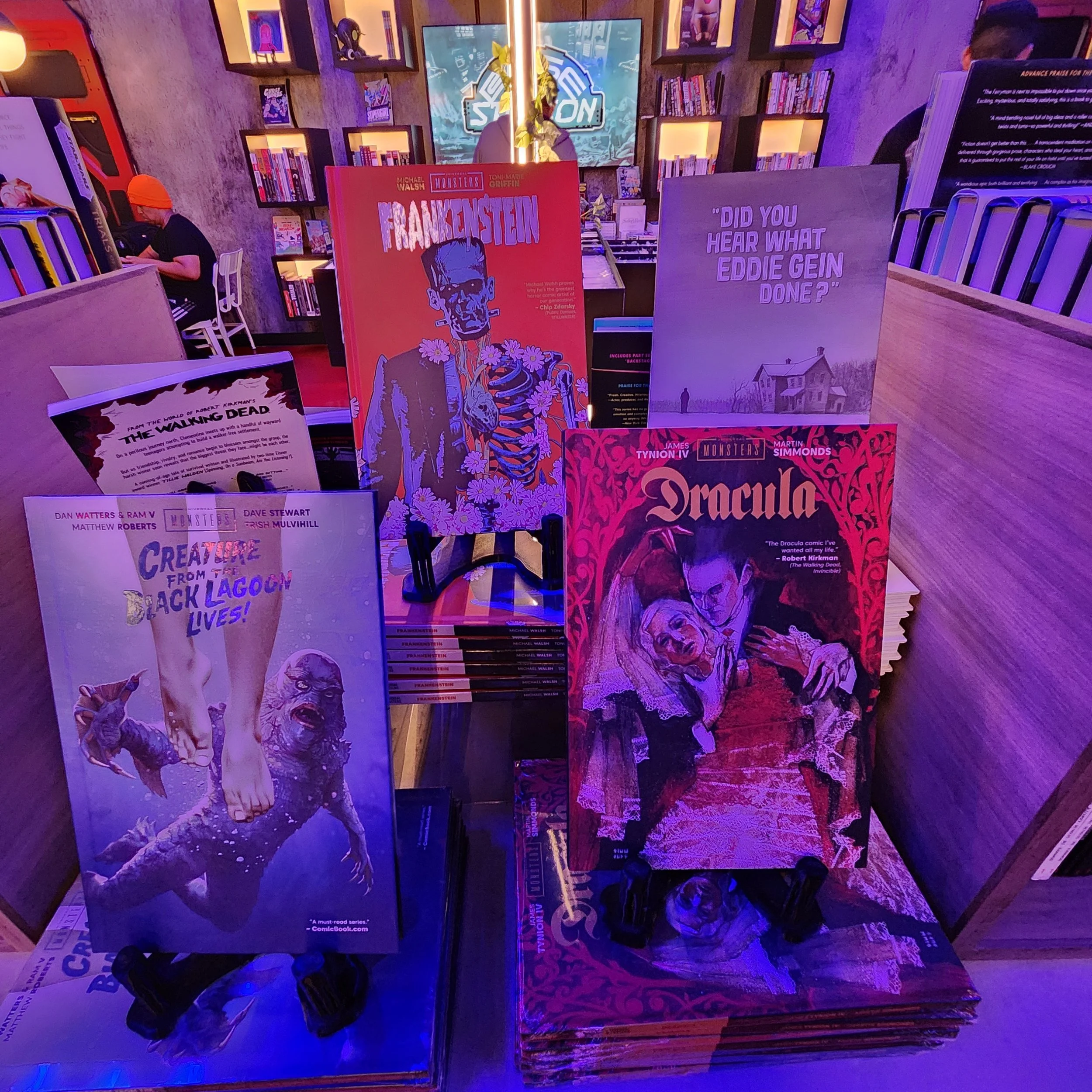
Revenge Of Display | Photo Credit: Scott Knoll
There are few traditions that are more revealing and still connected to a past time of entertainment than the telling of a ghost story. We are a people who built elaborate systems for explaining the world, only to spend our leisure hours imagining that is full things that we also cannot explain. We turn off the lights, gather around the fire, and invite our speakers to tell us about local legends, the house where no one lives, the road where no one stops, or the unknown that lurks within the woods that the tall trees hide. After, we insist that we do not believe in such things, naturally. Only to embrace the preference that we do not wish to dream alone.
In this collection of Campfire Tales, we venture into that unsettled territory, where folklore, fear, and the peculiarities of human nature share the same patch of darkness. The fire is still burning, the stories are waiting, and there is still time to decide if that noise was nothing. Consider this your warning: you may want to leave the light on and tuck young audiences in early, and please direct any nightmares to another campfire.
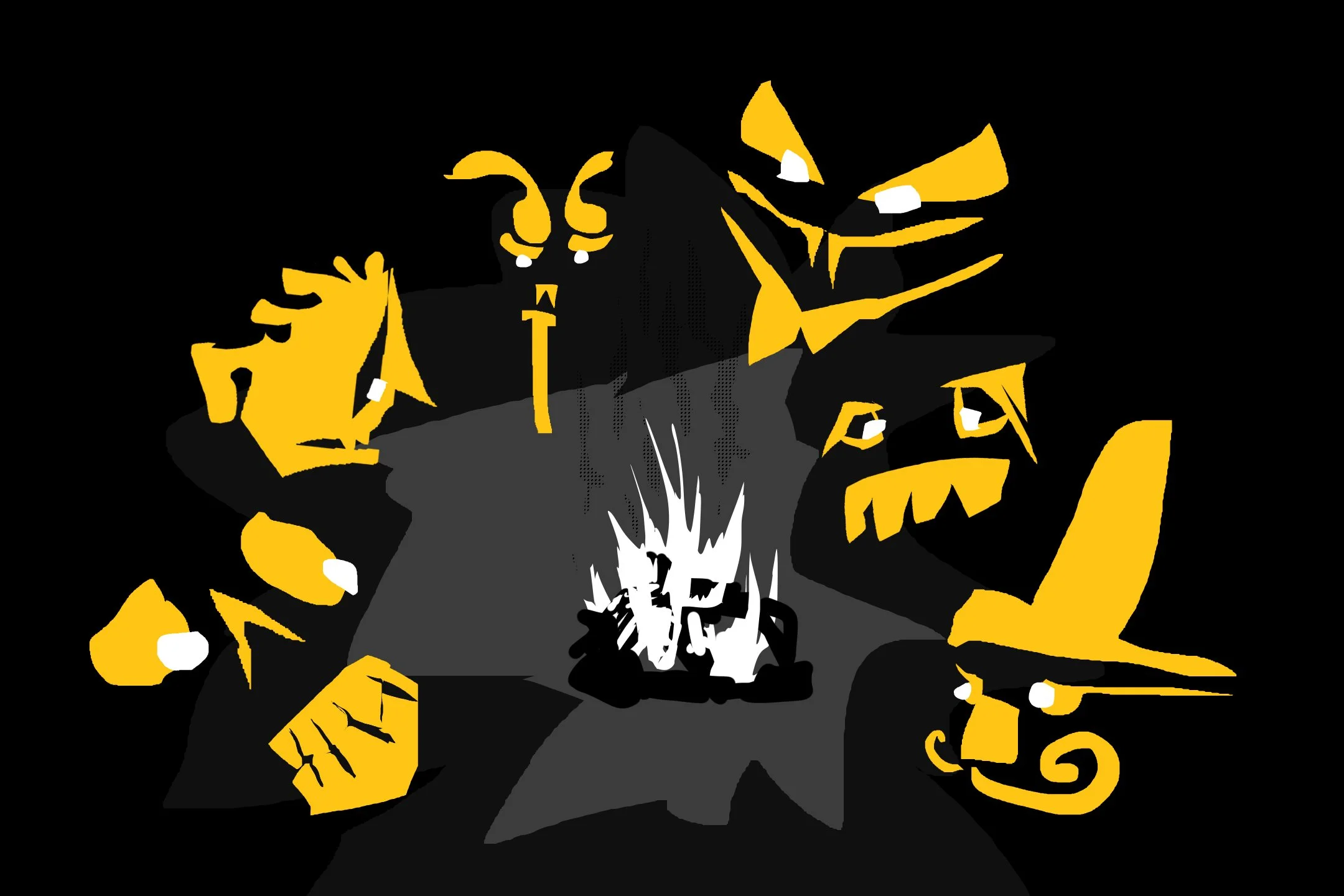
“Campfire” | Art Credit: Valentino Di Pietro Hernandez.
My Moon - Dylan Ferner Rose
“I could feel every part of me holding back, trying to stay in control, but the words totally failed me, just like they had failed you.”
For Readers who Enjoyed: The Wolfman (1941) • Ginger Snaps (2000) • An American Werewolf in London (1981) • Being Human (2011)
The werewolf has always been a creature of convenient timing and a staple of the monster line-up. In Universal Pictures 1941 film The Wolf Man, the full moon turns an ordinary man into a figure of tragic inevitability trapped between his familiar self and the supernatural animal the world insists that he is becoming. Since it’s debut in motion pictures, there has been several adaptations of the werewolf that expand both the animalistic violent urges as seen from Ginger Snaps and An American Werewolf in London and the torment that comes from the change as seen in the US and UK versions of Being Human. Dylan Ferner Rose’s work My Moon belongs to this tradition, but it’s not from the wilderness or the spectacle of the transformation itself. It is the placement of the werewolf myth alongside the rituals of modern courtship, where attraction requires a certain requirement of vulnerability and even the most carefully composed first impression can be undone. The building tension from the protagonists longing to stay tethered to the natural world provides the horror backdrop while the author finds humor pairing it with the romantic predicament. There is a recognizable tenderness in My Moon that readers can connect with: the desire to be understood, the fear of being truly seen, and the uneasy possibility that pursuing companionship may ask us to make peace with that part of ourselves we would rather remain concealed.
Further Reading from Behemoth Archives: Explore Jacob Reina’s fiction work, The Rabbid Mutt, and Mord McGhee’s Florets and Scars.
The Dark - Peter Cashorali
“We’re the prey they most prefer.”
For Readers who Enjoyed: Exorcist (1982) • The Blair Witch Project (1999) • The House of Haunting Hill (2018)
There is a peculiar kind of scary that starts when the safety of a known world loses all of its assurances, when a shadow in the corner or a sound from another room becomes impossible to dismiss. Writer Peter Cashorali’s poetic work The Dark carries these traditions, inviting eerily comparisons to the Exorcist, The Blair Witch Project, and The House of Haunting Hill, works that approach the unknown through different yet complimentary forms of dread: the violation of normal, a growing intensity, and things that cannot be simply explained. Like it’s cinematic counterparts, The Dark understands that fear can be a most effective tool when it leaves room for the imagination to expand around it and do its worst.
Further Reading from Behemoth Archives: Cashoralli’s other published poem The Birds and nat raum’s settling.
Flower Duet - Travis Flatt
“Would we chop you apart?”
For Readers who Enjoyed: Carnivàle (2003) • American Horror Story: Freakshow (2014) • Nightmare Alley (2021)
The travelling sideshow occupies an unusual space of the imagination and what is deemed human or supernatural, suspended somewhere between popular entertainment and unnervingly possible. Travis Flatt’s fictional work The Flower Duet occupies the umbrella shared by Carnivàle, American Horror Story: Freakshow, and Nightmare Alley, where the circus of curiosities becomes a miniature portrait of society, complete with its appetites, prejudices, and carefully maintained illusions. These works share a fascination with outsiders and performers whose lives unfold beneath the gaze of a wondering audience, where beauty and grotesquerie can be difficult to distinguish from. Yet, the carnival’s real mystery lies not simply in its marvels, but in the spectators recollection about what they think is extraordinary.
Further Reading from Behemoth Archives: John Gray’s poem A MARTYRDOM IN MEMORY and Asia Ali’s fiction work Charmed to Death.
Mrs. Candy - Zachary Lapinski
“If something hurts, her grandmother had always said, make yourself hurt somewhere else. That’ll cure the pain.”
For Readers who Enjoyed: The Babadook (2014) • Sharp Objects (2018) • Smile (2022)
There are a few things more frightening than a person who knows exactly how to make the world seem unbearable. In Zachary Lapinski’s fictional piece Mrs. Candy despair arrives in the form of an old woman with smeared red lips, a litany of grievances, and an alarming talent for turning typical anxieties into evidence of civilization’s decline. Beneath her complaints of politics, poisoned groceries, and her perspective on the general decline of society lies a more unsettling question: what happens when someone else’s misery becomes your own. Lapinski’s work recalls The Babadook, in which private anguish acquires the persistence of a household monster, and Smile, where suffering seems to pass from one person to the next like a disease that gathers force with every encounter. Like Sharp Objects, it also understands that the most disturbing hatred can be manifested from familiar relationships, where violence and softness may occupy the same room. Although Mrs. Candy does not produce a typical monster to fear, but a voice that sounds distressingly like the world outside. In a culture that rewards outrage and mistakes cynicism for wisdom, the story asks what happens when negative emotions stops being a feeling and felt as more of companion, and whether we can tell the difference.
Further Reading from Behemoth Archives: Megan P. Schub’s The Ether, Tom Miscara’s Song of the Siren, Billy Mitch’s Otherworld, and Jasmine G. Crawshaw’s The Pond - four works of fiction.
24 Hour News Cycle of Violence - Scott Wadlyn
“Sit. Think. We’re not the ones judging you here, Bob. God is judging you. Take it up with him.”
For Readers who Enjoyed: The Wicker Man (1973) • They Live (1988) • The Purge Franchise (Since 2013)
In Scott Wadlyn’s fictional piece 24 Hour News Cycle of Violence, horror becomes inseparable from the machinery through which we understand normalcy. The work invites comparisons to the Purge franchise, They Live, and The Wicker Man, three distinct visions of societies whose established familiar rituals and institutions conceal something more disturbing beneath the surface. Where The Purge imagines violence as a feature of public policy, They Live transforms mass persuasion into a science-fiction nightmare, and The Wicker Man finds unease in the customs of a seemingly self-contained community. Each suggests that panic and chaos need not arrive from outside the social order; it can emerge from the very systems that people learn to accept. Wadlyn’s work navigates its subject with a similarly unsettling awareness of how violence is presented, consumed, and woven into everyday life. Given the sensitivity of it’s content, the work merits a thoughtful approach. It is a work that asks what happens when the extraordinary becomes routine and how audiences reality can be affected by the constant reporting of violence.
Further Reading from Behemoth Archives: Explore Death by any other Name visual work by Marie Magnetic.
“a ribcage fails to bury the forgotten.”
For Readers who Enjoyed: Hereditary (2018) • The Outsider (2020) • Black Phone (2021)
In Audra Burwell’s uniquely formatted poetic work At the Intersection of Missing Children, the suspense begins before the supernatural enters the picture: the disappearance of a child. The work evokes the slow-building dread of Hereditary, the investigative unease of The Outsider, and the sinister atmosphere of The Black Phone, three works that find horror in the uncertainty surrounding violence, absence, and the limits of what we can understand. Each approach fear and intensity from a different perspective, whether through the lens of a fractured family, the unsettling details uncovered, or the vulnerability and trust of the young. Yet what connects them is the sense that something terrible can exist just beyond the boundaries of ordinary experience. Given the sensitivity of it’s subject matter, Burwell’s work encounters fears that carry real emotional weight. It is a piece that asks us to sit with the idea of what is missing, without offering the comfort of easy answers.
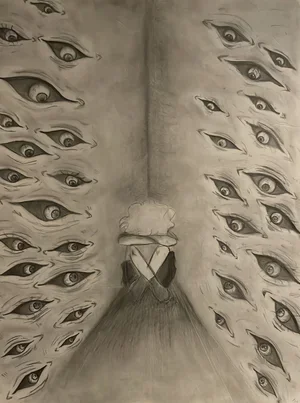
“Eyes on Me” | Art Credit: Mel Hamilton
Published in Issue 1.5
Still Portrait As a Mouse - Leah Mueller
“the tiny mouse inside your mother waiting for permission to emerge hiding with tail wrapped around itself like a cord of noodles.”
For Readers who Enjoyed: Pan’s Labyrnith (2006) • Coraline (2009) • The Bates Motel (2018)
In Leah Mueller’s still portrait as a mouse the ordinary rituals of childhood take on the strange, unsettling quality of a gothic fairy tale. Through the writer’s delicate natural and animal imagery and observations of family life, the poem recalls the uncanny domestic worlds of Coraline and Pan’s Labyrnith, and the psychological unease of Bates Motel. Each work finds ways to blur the boundary between fear and safety, suggesting that normalcy can be just as mysterious as the supernatural. The poems focus on the small, seemingly insignificant moments through which we try to learn to adapt to the world as we grow up around it. Similar to the television series and films, it understands that some of our fears manifest before we have the language to name them.
Further Reading from Behemoth Archives: Delve into Leah Mueller’s other published work Still Life with a Spiral Lollipop, Jennifer Montgomery’s poem The Monster, and Violeta Bjelica’s visual work Chair’s Missing.